How is the price formed on the stock exchange? A detailed look at price and volume.
Welcome to our exciting 7-day Trading Challenge! Today marks the kickoff of a challenge that will not only test your trading skills but also equip you with a wealth of new insights and strategies.
I hope you’re just as excited as I am because I guarantee you: the next 7 days will be a rollercoaster ride full of insights, aha moments, and – most importantly – real trading fun!
Trading is more than just numbers and charts; it is a craft that requires patience, precision, and a deep understanding of market dynamics. Each day of our challenge will immerse you deeper into trend-following trading, provide you with valuable tools, and inspire you. From the fundamental concept of price development to advanced trading strategies, we cover everything you need to be successful in the markets.
Welcome to your personal trading challenge!
For today, the first day in our series, we have a particularly important topic on the agenda: price development. This fundamental concept is the backbone of your trading craft. Without a solid understanding of how and why prices are formed on the market, it is almost impossible to make consistent decisions when trading.
But don’t worry – I’m here to break down this process into understandable parts and show you how you can use this knowledge for your trading strategy. With each day of the challenge, you will not only expand your knowledge but also build the confidence needed to navigate the markets safely.
Let’s embark on this exciting journey together and lay the foundation for your success in trading.
Trading begins and ends in the order book.
Trading begins and ends in the order book. This is our marketplace where our product is traded. You only see the price, the number of buyers required, and the number of sellers offered there.
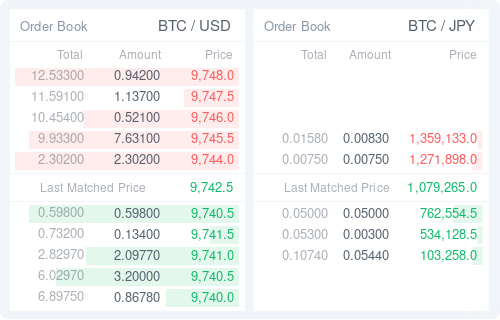
In this order book, only the price and the available volume are visible. We have no influence on it, so we have to deal with the big traders. Unfortunately, our personal opinion does not count at this point. If we are not the ones influencing the price, the only option left is to follow in the footsteps of the big traders.
But how is the price formed in the first place?
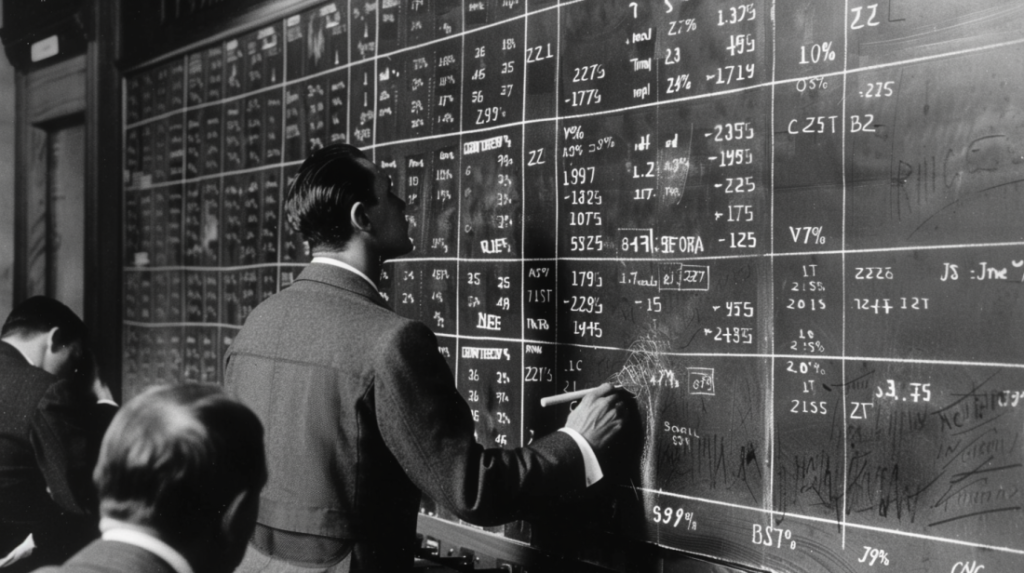
Until the early 20th century, there were no graphical representations of price movements as we know them today. Back then, price data was transmitted by telephone from New York’s Wall Street, similar to London, and manually noted on boards.
Traders relied solely on price information – a method that differs significantly from our current approach, where graphical charts are standard. This historical perspective not only shows the evolution of trading but also emphasizes the ongoing importance of understanding price and volume as fundamental elements for trading.
Price and volume contain all important information
As trend traders, we enjoy the luxury of not necessarily having to delve into the depths of fundamental analysis.
It does not matter whether we trade gold, EUR/USD, the DAX, or the Dow Jones; for us, two metrics are important: price and volume.
These metrics carry all the necessary information we need to make informed trading decisions.
The price not only reflects the current valuation of the market, but also all known and anticipated information that could influence the value. The volume, on the other hand, provides insight into the intensity with which a particular value is traded. It serves as an indicator of the strength or weakness of a price movement and helps us determine if a trend is present.
These two metrics are the foundation on which our strategy as trend traders is based. The ability to correctly interpret price and volume movements enables us to identify valid trends and align our trading decisions accordingly.
Price and volume are thus far more than just numbers; they are the language of the market.
By learning to understand and interpret this language, we position ourselves advantageously to use trends to our benefit. This knowledge and these skills are what distinguish us as trend traders and set us apart from the crowd.
How is the price on the stock exchange really formed?
As you have already learned, price and volume are responsible for the price and significantly influence its level.

When I ask traders in my webinars how the price is set on the stock exchange, I get one answer (you surely already know what’s coming):
“It’s clear; the price is set by supply and demand.”
From a technical standpoint, this answer is simply incorrect. This explanation primarily reflects a fundamental or economic perspective. However, as we have already discussed, the reality on the market is more nuanced. The price does not solely arise from the interplay of supply and demand.
Remember the beginning? We said the stock exchange is a marketplace. When the price on the stock exchange needs to be set, this core task of the broker comes into play.
Let’s look at this example from my education Trading with Logic.
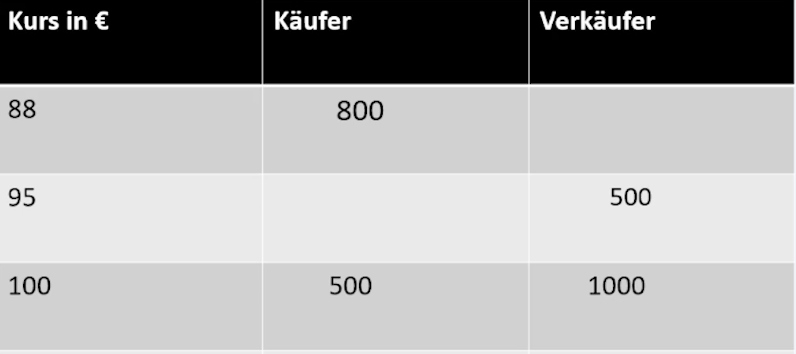
Take a hypothetical stock, whose specific name is irrelevant for our example. We have a closing price of €88, and the stock exchange is closed.
After the market closes, many traders show interest: some want to buy this stock, while others are willing to sell their shares.
As brokers, we now stand in the center as intermediaries, with buyer interest on one side and seller interest on the other. In our fictional scenario, buyer interest significantly outweighs; there are not enough sellers willing to sell their shares at the closing price of €88.
What happens now? In this case, we have an overweight on the buyer side, meaning there are not enough people willing to sell our stock at a price of €88. In our example, we only find these sellers at a price of €95. However, this supply is not enough to meet the demand of all 800 interested buyers – only 500 can actually buy at the price of €95.
The remaining 300 buyers, whose demand has not yet been met, must look for even higher-priced offers. They finally find sellers willing to sell at a price of €100.
This is how the new price is formed through the dynamic interplay of price and volume.
This example vividly illustrates how the market mechanism comes into play. The process of price formation reflects not only the immediate market situation but also the aggregated decisions and preferences of market participants.
It impressively shows how essential the understanding of price and volume is for trading, as they are the true drivers behind the scenes.
Now It’s Your Turn: Your Homework
Choose a financial instrument of your choice – this can be a stock, an index, a forex pair, or a commodity. Make sure you have access to daily trading data, especially price and volume.
Now take the closing price of any given day and note this value. Then take the opening price of the following day. Did the price open higher than it closed, or did it open lower than it closed?
From this, you can immediately see whether there were more buyers or sellers in the market. You can also use my example and look at the price. Next, compare whether the volume matches the respective opening and closing prices.
You can try this with several values.
Glad you stayed until the end, and enjoy your exercise.
See you tomorrow
Markus